
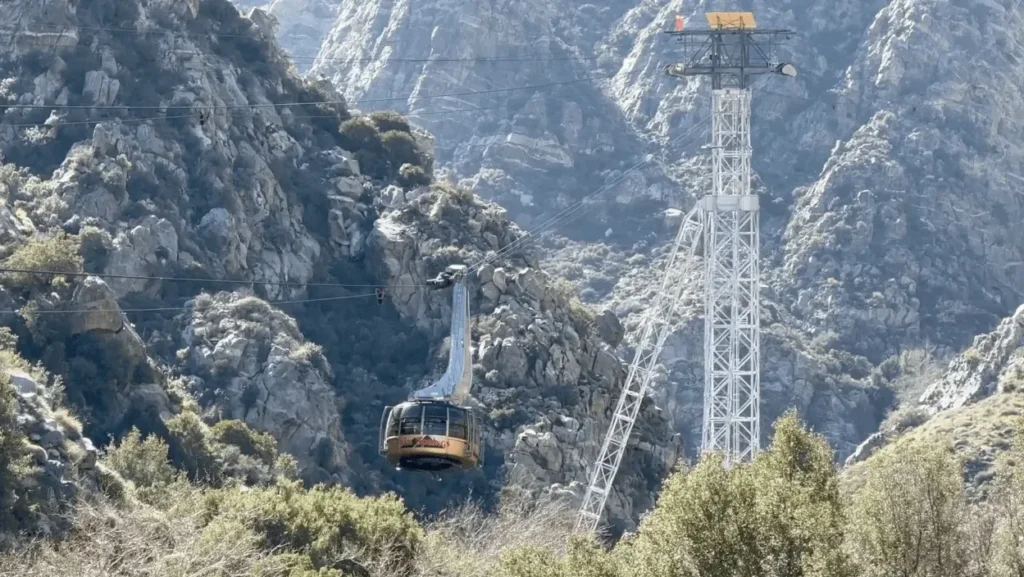
The Palm Springs Aerial Tramway takes you from Chino Canyon into a mountain setting in about ten minutes. The car turns slowly as it climbs, bringing different parts of the canyon into view.
You can go for the ride, views and a meal without setting off on a hike. But it helps to know what the ticket buys, where the tram ends and how different the weather can be at the top.
The key fact: the tram ends at Mountain Station, 8,516 feet above sea level—not at San Jacinto Peak. The ride gains about 6,000 feet in altitude. The station’s elevation and the height of the climb are not the same number.
This guide covers the ride, visitor planning and the history behind it. Prices and operator details were checked on 7 November 2026. Check the official pages again for your travel date.
Palm Springs Aerial Tramway at a glance
| Question | What to know |
|---|---|
| Where do you start? | Valley Station, 1 Tram Way, Palm Springs |
| Where does it end? | Mountain Station, at the gateway to Mount San Jacinto State Park’s high country |
| How high is Mountain Station? | 8,516 feet above sea level |
| How much altitude does the ride gain? | About 6,000 feet, according to the operator’s FAQ |
| How long is the ride? | About ten minutes each way, over roughly 2.5 miles |
| Must you hike? | No. Views, dining and indoor exhibits are available at the station |
| Is San Jacinto Peak the stop? | No. Reaching the peak means a separate, demanding hike |
| Can you buy tickets online? | Yes. The operator also lists day-of ticket-booth sales |
| Is it a downtown walk? | No. Arrange transport to the Valley Station and back |
Official tramway ride information and FAQ
What the tramway ride is like
The route crosses the steep sides of Chino Canyon. You start in a desert landscape and arrive in the mountain environment above it. The slowly rotating cars let different views come around during the journey.
The ride takes about ten minutes in each direction. That does not include parking, buying or checking tickets, waiting to board or exploring Mountain Station. Don’t schedule a meal or another attraction as though the whole visit lasts twenty minutes.
The tram cars are not air-conditioned or heated, according to the operator. Dress for the conditions at both stations, not just the temperature outside your hotel.
If heights or motion are a concern, read the operator’s sensory and access information before buying. This is a canyon-crossing cable-car ride, not an enclosed train through a tunnel. Check whether that kind of ride suits you.
Elevation, rise and the peak: three different things
The operator’s history page gives Valley Station’s elevation as 2,643 feet and Mountain Station’s as 8,516 feet. Its FAQ describes the altitude change as approximately 6,000 feet.
Those station figures explain why the rise is not 8,516 feet.
San Jacinto Peak is higher still. The tram is a way into the high country, not a lift to the summit. Decide whether you’re planning a station visit, a short trail outing or a serious mountain hike before booking the rest of the day.
Tickets, fares and what to check before paying
A dated official fare, not a price promise
On 7 November 2026, the official ticket page listed the adult online fare at US$36.95, including a US$2 online processing fee. Parking is separate for most visitors.
Use the official ticket page for current adult, child and senior fares, passes, terms and available dates. The number above is a dated reference, not a guarantee for a later trip. This site does not sell tram tickets.
If you compare a reseller or package, compare the full total and the terms—not just the first price shown. Check the date, fees, cancellation rules and exactly what is included.
Online sold out does not mean there are no booth tickets
The operator says that if tickets are sold out online, you can still buy at its ticket booth on the day of your visit. That is a useful distinction, but it is not a promise of instant boarding or a short wait.
For a tight schedule, do not build the day around arriving without a ticket and finishing at a fixed time. Check current availability and give the visit room in your plan.
Keep your confirmation and read its arrival instructions. An online ticket does not mean you can skip parking, any required check-in or the boarding process.
Getting to Valley Station and parking
Visitor address: 1 Tram Way, Palm Springs, California 92262.
Use the tramway’s Valley Station as your destination. Do not navigate to the State Park headquarters in Idyllwild; that serves a different side of the park and is not the Palm Springs boarding point.
The boarding station is outside the downtown walking core. The operator says there is no public bus or shuttle from Palm Springs to the tramway. Taxis and rideshares can serve Valley Station, but arrange your return plan rather than assuming an immediate pickup.
Parking is a separate cost
The official parking page listed US$15 for cars and motorcycles when checked on 7 November 2026. Availability and prices can change.
Follow staff directions to the appropriate lot. There is a signed guest drop-off and pickup area, and designated accessible parking requires the proper permit. Parking is not automatically included in an ordinary ride ticket.
Some qualifying local residents and pass holders have parking benefits, with proof required. Check the actual rules if that might apply to you. A State Park day-use pass is not the same thing as tramway admission or tramway parking.
Official parking, drop-off and eligibility rules
Hours and the best time to go
The right time depends on your plans, the forecast and the current timetable. No time slot guarantees quiet cars or clear skies.
Before leaving, check three separate times on the official hours page:
- The first tram up for your day.
- The last tram up.
- The last tram down.
These are not interchangeable. A restaurant booking or a long hike does not extend the last return tram.
The schedule is seasonal, with holiday changes. At the research date, the published winter timetable covered 5 October 2026 through 27 May 2027. Don’t apply an old summer timetable to a winter visit or assume a later Friday return runs all year.
Check operating alerts as well as ordinary hours. For an evening visit, allow time to eat, return from any walk and reach the boarding area. Sunset visibility, a particular sky color and a short return queue are not guaranteed.
What to do at Mountain Station
Enjoy the views without making it a hiking day
Mountain Station has observation decks, indoor exhibits, a small natural history museum, documentary theaters and a gift shop. You can spend the visit around the station rather than treating a trail as compulsory.
Check the weather before choosing the decks or planning an extended outdoor stop. A hot day in Palm Springs does not tell you what to expect at this elevation.
Choose the right dining option
The operator lists two main restaurants at Mountain Station:
- Peaks Restaurant: a sit-down option. Reservations are recommended.
- Pines Café: a cafeteria-style option, also used for the Ride ‘n’ Dine offer. It does not take reservations.
There is also Lookout Lounge at Mountain Station and Cascade Café at Valley Station. Check each venue’s current hours and menu rather than assuming all food outlets stay open until the last tram.
Ride ‘n’ Dine is a specific tram-and-Pines meal product. It is not a booking at Peaks, and a Peaks restaurant reservation should not be treated as tram admission. Check the full package total and terms on the official pages; processing fees can affect the displayed amount.
Use Long Valley as a trail choice, not a promise of easy access
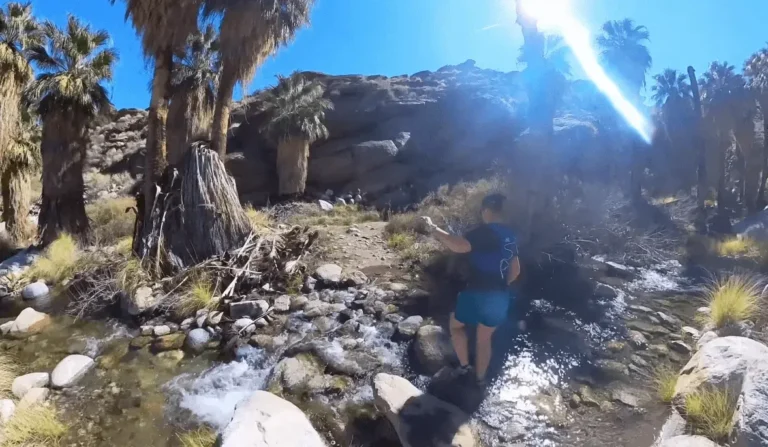
The operator’s hiking page describes a concrete path descending from Mountain Station to Long Valley. Trails then lead into the park. A level-looking trail description does not describe that entire approach or the climb back to the station.
Two shorter routes to compare are:
| Trail | Operator’s description | What to check |
|---|---|---|
| Long Valley Discovery Trail | Three-quarter-mile loop, described as easy and level | Approach from the station, current snow/ice and the return climb |
| Desert View Trail | 1.5-mile loop, short climbs, described as moderately strenuous | Your group’s ability, trail conditions and return time |
Ask the ranger about the route and current conditions before setting out. The tramway FAQ says Long Valley trails do not require a permit, while entering the wilderness beyond the ranger station does. Check the rules for your actual route; a tram ticket is not a wilderness permit.
Treat San Jacinto Peak as a separate mountain plan
The operator lists the summit hike as 5.5 miles one way. It is not a short walk from the observation deck.
A summit attempt needs its own preparation, suitable equipment, permit checks, current trail information and enough time to get back before the last tram. This article is not a turn-by-turn summit guide. Don’t add the peak to a casual sightseeing visit because you are already partway up the mountain.
Official trail descriptions · California State Parks conditions and wilderness rules
A short history of the Palm Springs Aerial Tramway
The ride is quick. Getting it built was not. The tramway’s own history traces the idea from the 1930s through years of political delays, fundraising and difficult construction.
From a 1935 idea to a 1963 inaugural ride
Electrical engineer Francis Crocker imagined a tramway in 1935 while looking toward the cooler San Jacinto Mountains during a hot day in Banning. Desert Inn co-manager O. Earl Coffman helped turn the idea into a project.
World War II delayed the plans. In 1945, Governor Earl Warren signed the measure creating the Mount San Jacinto Winter Park Authority, the public body that governs the tramway. More delays followed before construction began in July 1961.
The operator’s history records US$8.15 million in private revenue bonds raised for construction.
Building across Chino Canyon meant getting people and materials to places without road access. The first supporting tower could be reached by road; helicopters helped build the other four. The operator records about 23,000 helicopter missions over twenty-six months of construction.
The inaugural ride took place on 12 September 1963. Those years of planning are a useful part of the visit: the canyon outside the window is also the reason the construction was so difficult.
The rotating cars arrived much later
The tramway opened in 1963, but today’s rotating-car experience came from a later upgrade. A modernization program was announced in 1998, and passengers began riding the new rotating cars in September 2000.
That is why an old cabin in a historic photograph does not look like the car in a current picture. The opening date and the start of rotating-car service mark different stages of the tramway’s history.
Mountain Station’s more recent restoration
Work on Mountain Station began in 2019 and was completed in early 2023. The operator describes the project as updating building systems while restoring the architectural vision of Stewart Williams.
The station is not just a place to step out of the car. Its decks, indoor spaces and setting are part of the outing, especially for visitors who would rather enjoy the architecture and views than hike.
Weather, clothing and access: decide before you go
Check mountain conditions, not just the desert forecast
Bring layers and suitable footwear. Mountain Station can be much colder than Palm Springs, and winter conditions can include snow and ice. Snow is not guaranteed on a particular date, and a snow-covered landscape does not mean the trails are suitable for a casual walk.
Use the operator’s weather page and current operating notices, then check State Park advice if you plan to leave the station. Bring drinking water rather than relying on finding it along a trail.
Choose the station-only visit if you don’t have the time, equipment or conditions for the trail you had in mind. A tram ticket is not a reason to push on into unsuitable weather.
Accessible stations do not mean accessible wilderness trails
The operator lists Valley Station, the tram cars and Mountain Station as accessible under ADA guidelines, with accessible routes, elevators and restrooms. Its access page also offers sensory information and assistance contacts.
The State Park trails are different: they have uneven, unpaved terrain and are not covered by the same accessibility claim. Check the exact route and the approach into Long Valley, not just whether you can board the tram.
If you need help with a particular part of the visit, contact the operator ahead and review its current accessibility information. Don’t assume another visitor’s experience will match your needs.
Check family, pet and health rules separately
The operator says children under sixteen must be accompanied by an adult aged twenty-one or older. Check current child fares and boarding requirements directly, especially for very young children.
Pets are not allowed on the tram. Trained service animals are permitted under the operator’s rules; companion and emotional-support animals are not treated as service animals.
If you’re pregnant or have health concerns about the ride or altitude, talk with your doctor before booking. This is travel information, not medical clearance.
A simple way to plan your tramway visit
For a views-and-history visit, check operating status and tickets, travel to Valley Station, ride up and spend time around Mountain Station. Add a meal if you want one, then return with room before the last tram. No hike is needed.
For a short-trail visit, do the same checks, then choose a route based on current conditions and your group’s ability. Leave time for the approach, the return climb, station stops and the tram down. Set your turnaround plan before setting out.
For a summit or winter-sports trip, make a separate mountain plan. The sightseeing outline above is not enough. Check the park’s conditions, permits and equipment needs as well as the tram schedule.
There is no single visit length that covers all three. Keep the rest of the day flexible instead of treating a published “typical time” as a finish-time guarantee.
Palm Springs Aerial Tramway questions
Is the tramway worth it if I don’t hike?
It can be, if you want the ride, mountain views, station exhibits or dining. You don’t need a summit goal to make a visit worthwhile. Check the weather and current fare, then decide whether that kind of outing suits your trip.
Does it take you to the top of Mount San Jacinto?
No. The tram ends at Mountain Station, at an elevation of 8,516 feet. San Jacinto Peak is reached by a separate hike. Don’t mistake a photo from the summit for the view from the tram’s arrival station.
Do tickets guarantee no waiting?
No guide should promise that. The operator sells advance tickets and lists day-of booth sales even when online inventory is sold out. Follow your booking instructions and allow for the rest of the arrival and boarding process.
Can I go for dinner without a tram ticket?
A dining reservation is not a ride ticket. Peaks is at Mountain Station, so check tram admission, restaurant arrangements and the last return before planning dinner. Ride ‘n’ Dine is a different product tied to Pines Café.
Is it open every day of the year?
Don’t rely on that assumption. The operator publishes regular hours, but operating alerts, maintenance and other closures can change access. Check the live site before traveling and use the timetable for your actual dates.
When did the rotating tramway open?
The original tramway’s inaugural ride was in September 1963. The rotating cars began carrying passengers in September 2000. Both dates matter; they describe different parts of the story.
The best plan is a clear one: know which station you’re visiting, what kind of mountain outing you want and how you’ll get back. Then leave enough room to enjoy the ride instead of racing through it.
—
Plan more of your Palm Springs trip
- Best things to do in Palm Springs: the top sights and experiences
- 24 hours in Palm Springs: a one-day plan from breakfast to nightcap
- Hidden history of Palm Springs: the places and people behind the resort story
- Downtown Palm Springs guide: what to see, eat and do on Palm Canyon Drive

Shihab Uddin is a city explorer and the editor of Secret Palm Springs. He loves digging into what makes a city tick: its history, its neighborhoods, and the places locals actually go. For Palm Springs, he builds each guide from official sources like the City of Palm Springs and the Agua Caliente Band of Cahuilla Indians, checks current hours and prices, and reads recent visitor reports. Pages are updated when details change.